Saturday, February 03, 2007

Panama --> Galapagos --> Easter Island --> Pitcairn --> Mangareva (Gambier Islands) --> Tuamotus --> Tahiti

Ho guys,
 
Monday, 5 February 2007,  we will clear out of Panama to begin our longest passage so far.  There have been a few changes in our plans and the itinerary looks now like this:   
 
Panama --> Galapagos --> Easter Island --> Pitcairn --> Mangareva (Gambier Islands) --> Tuamotus --> Tahiti
 
This way we can't go to the Marquesas, which originally was one of our main goals, but as almost everybody else is going there - The Fleet they call it these days - we decided to forgo that route.  Most of the anchorages are tiny and I can't imagine how the Polynesians feel when hundreds of boats suddenly show up at their doorstep. 
 
We took on provisions, so that we are slightly loaded down at the moment.  Still floating above the waterline for some reason.  We had to find space for 200 liters of tonic water, 60 liters of rum, 40 cases of beer, 120 liters of Chilean wine, 15 liters of engine oil, 10 liters of gear lube, 460 liters of diesel as well as 750 liters of water.  Also we got dried mushrooms and fungi of different kinds, thousand-year-old eggs, dried jellyfish, Chinese pickled vegetables, pickled cucumbers, dried shrimp, canned squid & octopi, salteggs, water-chestnuts, bamboo sprouts, dried and pickled mustard greens, dried radish, sha cha sauce, oyster sauce, bean paste, spicy bean paste, black saltbeans, mung beans and other assorted delicacies.  Of course we also bought lots of juice, coffee, tea, tang, syrup, evaporated as well as UHT-milk and milk-powder, flour, sugar, noodles, rice, black bread, 72 packs of instant noodles from Taiwan, potato buds, five pounds of gummy-bears and other staple foods.  I should not forget the 100 cans of fruit, vegetables and meat.  Then there are ten bottles of rice wine and two bottles of Chinese pineapple-spirits for cooking, yeast, butter, margarine, shortening, baking powder, baking soda, spices and nuts.  Finally Liping reminds me that there are plenty of cookies, crackers, granola, potato chips and other tidbits for the night watches. 
 
Nor is this all, as our deep-freeze is completely empty, and we are planning to fill it to the brim just before we pull up the anchor.  It may sound a bit crazy, but as we know the prices down where we are going, we think this may prove to be a worthwhile investment.  Most of the stuff should last us for up to a year or at least all the way across the Pacific. 
 
I don't think we will spend a lot of time on Easter Island or Pitcairn, as the anchorages there are supposed to be atrocious.  Also, we are not particularly interested in making a fast passage and intend to reduce sail at night, in order to lower the chances of sudden stress and improve our sleep.  I'll be taking the first watch until about 1:00 o'clock, while Liping will take the second one until daybreak when I will take over again.  This seems to be the best solution since little Aurora Ulani sails with us. 
 
We'll be completely out of touch until we find an Internet Cafe somewhere, which will probably in Papeete or some such.  Anyway, I don't think we'll lack drink or food <grin> and if all goes well, it should be a most interesting trip. 
 
Until then best from Aurora Ulani, Liping & Holger  --  S/V DHARMA BUM III

Tuesday, December 26, 2006

LET'S PANIC!!!!

When we finally made the decision to get a date for the Panama Canal transit, the scheduler said: "Today....." and my heart seemed to stop beating.  Until he continued "we don't have any slots" and I could almost breathe normally again.  We could have gone through two days later, but I asked to be scheduled for Wednesday, 20. December 2006.  Three days to find two more line handlers, buy polypropylene rope to hang the ten tires all around DHARMA BUM III, get the food shopping and preparation done, make space for all the people aboard, plus a multitude of smaller chores. 
 
We agreed that all would go under the motto:  LET'S PANIC!!!!
 
But somehow we stayed reasonably calm until just before and when the anchor came up without any major trouble, the line handlers and the advisor were on board, things were almost relaxed.  One of the reason was the advisor Rick, of Chinese ancestry, and making a very competent impression right from the start.  He explained everything beforehand, made drawings and asked questions to check that we understood.  Helmut from Austria had gone before, while Darrel and Loretta Smith from the Privilege 37 catamaran CANKATA were as new to the canal as we were.  Of course, it had become night by the time we took off.  Normal for a transit from the Caribbean to the Pacific side. 
 
First we waited for a cargo ship, but it came in so slow, that we went to the lock first.  When the ship was in, we approached the starboard wall, picked up lines, repeated the procedure on the other wall and as soon as we were secured the bell rang, the gates closed and water began to pour in.  The turbulences were impressive, but we were secured by our four heavy lines center-lock behind the freighter.  It went as smooth as a commercial.  The next two chambers were exactly the same and in no time at all we were in the Gatun lake, where Rick switched on his pocket-GPS and guided us to the huge mooring buoys. 
 
The pilot-boat shone their big searchlights onto the buoys and Darrel jumped across to fasten our lines.  Not as easy as it sounds, for although they are about three meters across, they are also covered with "Pelicanite" (guess what that is), which gets very slippery when wet and exudes fumes that make one wish for an oxygen-probe or at least a canary. 
 
All went well and we had a nice dinner in the cockpit.  Around midnight everybody was asleep. 
 
At 5:30 the next morning, I went into the two engine rooms, to top up motor- and transmission-oil, check the belts and the water.  Our speed in the canal was an average of 6.5 knots, but the Panama Canal Authority ACP insists that the boat must be able to make 8 knots when going full speed.  An Irishman we met in Colon had to pay an extra US$ 850, as his boat was so slow that he couldn't transit the canal in the required time.  I had no intention of emulating his experience. 
 
About an hour later, an elderly advisor and a young trainee, both of African ancestry, jumped on board carrying with them all kinds of dirt on their shoes, for it had just rained heavily.  The stench from the mooring buoy got almost overpowering.  Unfortunately, things went steadily downhill from there.  The trainee was polite and friendly, but whenever he gave me instructions, the advisor countermanded them.  Rick had told us, that we should always stay inside the channel on the starboard side, as it was ACP policy that all vessels should pass port to port. 
 
This new advisor, however, had us sometimes on the starboard side, sometimes on the port side and at other times completely out of the channel.  He was fond of short-cuts and continually urged me to go at full speed, even when already inside the lock, only to say a second later that I should reverse.  He was definitely getting on everybody's nerves, probably most on those of his trainee. 
 
The trip through the lake was beautiful, as the drowned jungle with wisps of mist and cloud looked positively enchanted.  We sighted one alligator, which swam close to shore and we really enjoyed that part of the passage through the canal. 
 
At around 11:30 a.m. we arrived at the downhill locks with no other boat or ship in sight.  To our great surprise, we didn't have to wait at all, but went through all alone, which didn't quite go as smoothly as with our previous advisor Rick.  First, the new advisor wanted to persuade me to go down along the wall, which I refused.  Fortunately the captain of a vessel has the final say in all these decisions.  That didn't please the advisor and when we went in the lock, something didn't work out with the communication between advisor, trainee and the line handlers on shore.  We were tied up at an awkward angle, so that I constantly had to reposition the boat with the help of my two 40 HP Volvo-Penta engines.  Good to have in moments like that.  When sailing, we don't use them at all, as the solar panels and the wind generator supply all the electricity we need. 
 
While we were in the last lock and everybody was busy as hell, the advisor announced repeatedly - and with a louder voice each time - that it was time to eat and created quite unnecessary stress that way.  Needless to say, he ate at least twice the amount of his trainee or anybody else on board. 
 
Still, we made it to the Pacific without mishap and by 2:00 p.m. we dropped anchor behind Flamenco Island.  You can't believe how happy we were to be back in the Pacific one more.  The change was almost startling.  Not only are the tides extremely high on this side, but when you look at Panama City with its skyscrapers, wide avenues, trees and parks, you can't quite believe that it belongs to the same country as slum-like and outright dangerous Colon. 
 
After a couple of days, we re-anchored on the other side of the causeway, because it is a lot more protected.  Also there are a lot more boats at La Playita de Amador.  Here we ran into Dennis and Linda from DREAM MAKER, who are taking care of our sails which got badly damaged in the storm off Colombia. 
 
We made a trip to the Balboa Yacht Club, which is booked out for two weeks and were put on a waiting list.  While Dennis, Liping and Aurora Ulani went food shopping at the local REY Supermercado, I talked to my family back in Flensburg.  They had already started on their Christmas dinner. 
 
When it was dark, Santa Claus came to DHARMA BUM III as well.  Aurora Ulani ripped off the gift wrapping from her bicycle - she is riding it in the spacious cockpit right now - and the brown furry rabbit, the boat got a foresail made of Mylar, Liping got a nice dinner ashore and I finally got a speargun.  Karl and the delicious dinners of Big Eye had convinced us, that a speargun was not only a necessary survival-tool, but helps to enrich the food supply considerably. 
 
So we made Christmas in the Pacific after all and if we get the visa for French Polynesia in reasonable time, we can soon take off for the Marquesas and the South Seas.  We really are looking forward to that trip! 
 
Latitude: 08°54.61'N  Longitude: 079°31.54'W
Monday, December 18, 2006

DHARMA BUM III going through the Panama Canal

Ho guys,
 
We'll be starting to go through the canal in the dark, on Wednesday, 20. December 2006 at around 5:00 pm Panama time (UTC: 10:00 pm, Germany: 11:00 pm, Taiwan: Thursday, 21. December 2006 at around 6:00 am).  As the locks are very well lit, you might be able to spot us at:


If possible, I´d like a copy of a photo of DHARMA BUM III going through the Panama Canal.  :-)
 
 
Cheers!
 
Holg

Thursday, December 07, 2006

Bequia --> Panama

After about seven months in Trinidad we sailed to Bequia, where we spent almost another month in pretty much perfect surroundings.  Excellent holding ground, lobsters and moray-eels living right under the boat, the beach white and fringed with palm-trees - one could get used to that.  Plenty of charter boats and sky-high prices, though. 
 
Anyway, the GRIB-Files indicated reasonably good weather for the next eight days and so we weighed anchor and took off towards Panama.  Liping took just 25 mg Meclizine Hydrochloride and didn't have any problems with sea-sickness whatsoever.  Aurora Ulani had to throw up about three times for the first three days and I was slightly nauseous for about four or five days.  Fortunately that was it. 
 
All went smoothly until we came into the vicinity of Maracaibo in Venezuela.  However, as soon as we were off Colombia, conditions began to deteriorate.  Not that we had squalls or the usual kinds of bad weather.  It stayed pretty much sunny all the way until we reached Panama.  It was just that the wind got stronger and stronger. 
 
When we had steady 40 knots, I began to take in sail and thought that things would soon go down to 35 knots or, preferably, a tad lower.  Instead, the winds picked up until we had steady 50 knots with mountainous following seas (my guess is between five and eight meters).  I was amazed, because I just could not believe that we were having this kind of weather in the Caribbean - and with the sun shining to boot. 
 
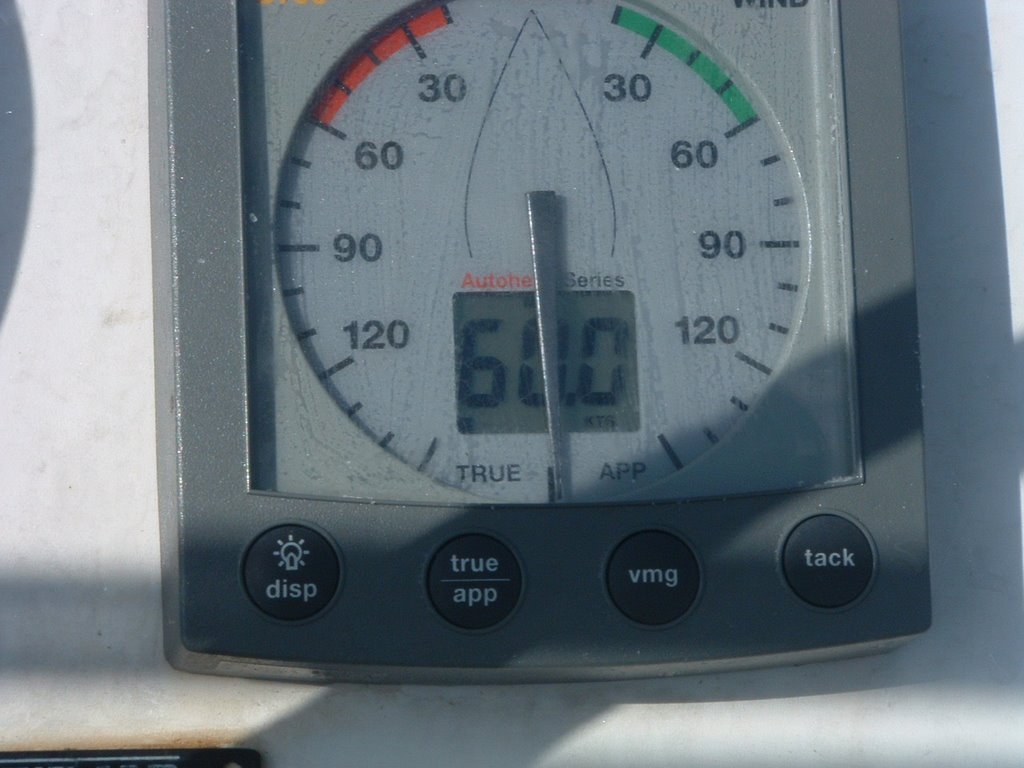
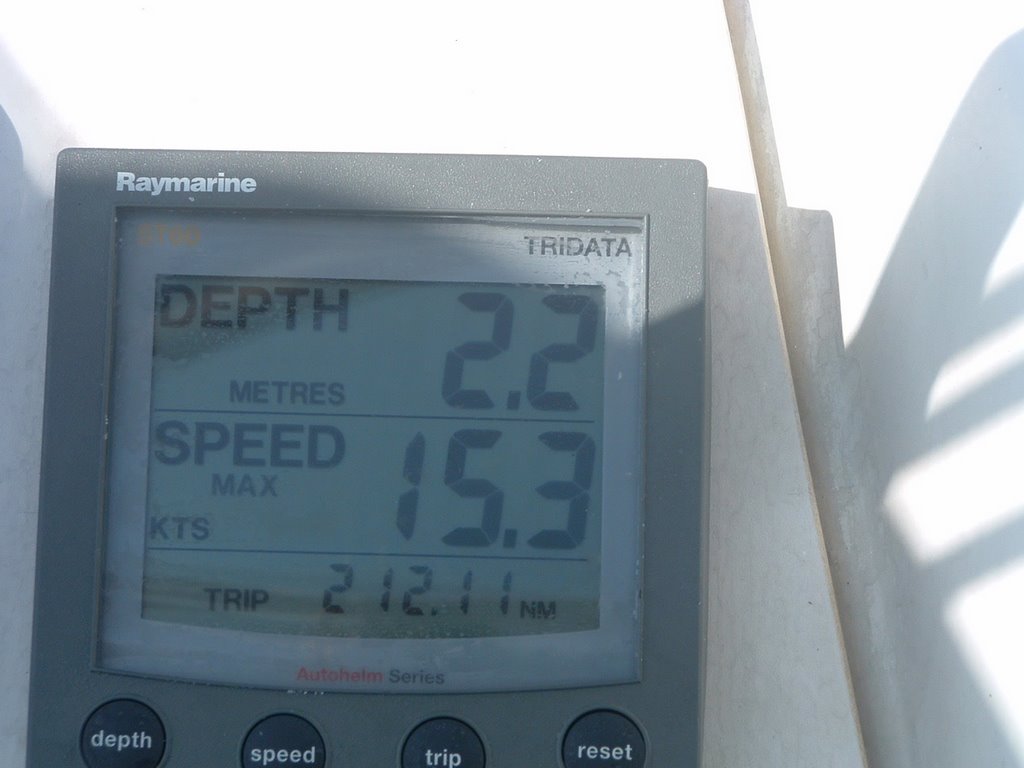
We had noticed that the winds picked up as soon as it got dark and the instruments seemed to bear out this observation.  All seemed to be going reasonably well, until I noticed that this time the wind climbed up from the 50+ knots to 60 knots.  (We had just the tiniest scrap of the jib up, because otherwise we would go sideways to the seas.  We surfed at 15+ knots at that time.)  That's when I finally got really scared, because the word hurricane kept popping up in my head.  And after the typhoon we experienced in September 1994 in Taiwan (a window blew out, glass pierced the plywood I put to replace the window, sofa & arm-chairs flew away, a heavy steel washing machine disintegrated &c. &c. ) I had absolutely no illusions as to what would happen to us, if we were in the dangerous semicircle of a hurricane. 
 
Blue water came over the deck and more than once a wave broke right into our cockpit.  Unfortunately our sails suffered badly as well.  The jib developed a hole, which enlarged itself within seconds to impressive proportions, but I didn't dare to take it all in.  Earlier on the main had ripped itself off the first three mast-sliders.  I was sitting at the wheel in foul-weather gear, harness and life-line, in order to correct our course if the boat should get out of control while surfing.  When things were at their worst, that happened every two minutes or so.  I had the feeling that we might not make it this time.  Fortunately it was only my fear speaking. 
 
In the morning I saw a cargo-ship beating towards weather (probably bound for Cartagena) and making heavy work of it.  I called the captain on the VHF and asked for the weather report.  He was kinda busy at the time, but about half an hour later he came back and read it to me.  Surprisingly the weather report talked of only 25 to 35 knots of wind and a maximum swell of 4 meters.  No change for the next 48 hours.  When he signed off, the captain shouted: "Good luck!!!"
 
It took us a little while to get to Panama and while the situation got slightly better, it never got reasonably comfortable.  At any time, the winds would go up to 40 or even above 50 knots, while the sea was confused and exceedingly boisterous.  And, of course, it was around midnight when we arrived.  Nothing to do, but take down all sail and wait for daylight. 
 
We reported to Cristobal Signal Station, had to wait for one cargo-ship to go through the small entrance and anchored in the flats not much later.  
 
~~~~~
 
What we got to hear in the few days since we arrived, has made us reevaluate the whole experience.  Nobody here remembers anything like this storm.  Of 18 yachts in the anchorage, 16 dragged anchor and one yacht got lost and sank (divers floated her again already).  Three cargo-ships got thrown ashore.  Two biggies collided out in the roads and most of them left to avoid a similar fate.  Apparently 16 people died here as a direct result of the weather. 
 
~~~~~
 
We have had our boat measured today and we are thinking of going through the Panama Canal in a week or so.  It'll take two days, but we know that the Pacific is waiting on the other side and we are more than eager to sail on to the South Seas once more. 

Wednesday, November 22, 2006

Bequia --> Panama

We are in Bequia (St. Vincent & The Grenadines) and have just checked out to sail to Panama tomorrow. Very nice place here with good holding ground and lobsters right under the boat.

Saturday, October 21, 2006

Scotland Bay, Trinidad -- Friday, 20 October 2007

Last time I went to immigration here, the guy said:  "You have to leave the island!"  When I remonstrated with him that DHARMA BUM III was not ready and that this wasn't my own fault at all, he replied:  "Your boat has a problem.  You don't.  You have to leave the island!"
 
I could try again with a different officer, but this is getting a bit ridiculous.  So, I am planning to clear out on 10/25 and then go for a little sail to Bequia, the Tobago Cays, Carriacou, Greneda and then back here to Trinidad. 
 
These days I am spending the nights over in Scotland Bay in the company of a horde of howler-monkeys and my good friends Kar(e)l & Libu Hauschke, whom I met in French Guayana in 1989.  Karl is a famous mountain-climber from the Czech Republic.  ("New generation of climbers of the fifties and sixties together with a group of young local climbers threw themselves into climbing very demanding cracks and marking up new routes. One of them was Karel Hauschke (nicknamed "Koksa") who became famous by his original ascents at difficult never-climbed walls in Adrspach. The Valley Route at the Duke (marked out and climbed along with Jan Zalesky) crossed the huge Valley Wall and the Dwo-day Route was the first of many cracks leading to the top of Pegasus. A year later, Koksa made the famous Aerial Route on Mistress. Two weeks later, he and Vaclav Hornych climbed the Long Corner opposite the Lovers. In the following years, Karel Hauschke and Jaroslav Krecbach ranked about the best climbers. Routes such as Dechac on King, the Mushroomers' Route on Tooth and the Magic Route on the Koksa Spire rank among the most famous. The last one was climbed and marked out together with Vladimir Meier a co-author of the impressive Vault Route on Castle.")
 
He designed and built his boat ROSINANTE and Karl & Libu have lived on the boat since 1972, raised and home-schooled two children and sailed around the world.  They go spearfishing all the time and find lots of fruit and vegetables in the jungle.  And, of course, they are very fond of good food, good drink, and good parties.  :-)))
 
We should be back here pretty soon, as there is still a lot of work to be done on the boat.  I still plan to be in the Marquesas Islands by Valentines Day 2007 - so I'd better get going!

Monday, August 28, 2006

VESLA -- armed robbery with guns

In the night from Wednesday to Thursday  (17 Aug '06) at between 2:30 and 3:00 a.m. the skipper and crew of S/V VESLA from Norway were chatting in the cockpit of their sailing vessel, while their guests Paul from the U.K. and two German girls were down below.  A dinghy with several black Trinidadians came alongside asking for a drink and cigarettes, which Torbjørn, Einar and Christian were happy to provide. 
 
Suddenly one of the people out of the dinghy came aboard, wielding a gun and asking the people in the cockpit to empty their pockets.  He was accompanied by more people from the dinghy who were armed with machetes and knives.  The armed intruders then proceeded to get down below, where they apparently produced another gun and woke up the people down below with a gun to the head. 
 
They then proceeded to ransack the boat, taking two laptop computers, scuba-diving gear, cameras, video-cameras, a battery charger, binoculars, knives, alcoholic drinks, a watch and so on as well as all the money and credit cards they could get their hands on.  In the process one of the intruders touched and "felt up" at least one of the girls, they went through the backpacks and kept asking about more money.  At the same time they started hitting one of the crew with the broad side of a machete, getting more violent when that didn't produce the desired results. 
 
The whole search of the boat took about 1 1/2 hours and the only thing of value not taken were a bunch of travelers' checks and a credit card that the robbers had apparently overlooked.  Even the souvenirs including an African drum as well as the photos and videos were taken. 
 
Just before they left, the robbers threatened once more with the gun asking for the rest of the money and then stabbed the dinghy about 20 times.  Finally they took off towards the open sea. 
 
The skipper immediately got on the VHF radio channel 16 in order to send out a call for help.  He was informed that he would have to call for the Coast Guard specifically and got a response apparently from the Coast Guard, which advised him to change to channel 11.  He was told that somebody would be there in about 30 minutes, but since nothing much happened in that direction he called again about 1 1/2 hours later.  After about two hours altogether the Coast Guard actually showed up, spend about five minutes on board and then left again. 
 
Meanwhile other sailors from the yachting community provided immediate assistance and skipper and crew would like to stress that the help they received from this direction, as well as from YSATT, the management of Power Boats, Peake Yacht Services and Jesse James of Members Only was invaluable and greatly appreciated.  The local dinghy-repair-shop offered to repair their slashed dinghy free of charge, a fellow yachtie donated an outboard engine - theirs was waterlogged in is probably destroyed - Peake Yacht Services offered free dock space and a hotel room, Power Boats offered to put their boat on the hard for free and Jesse James offered a free trip around the island so that they could see for themselves the beautiful side of this island. 
 
In other areas a certain amount of miscommunication seems to have taken place.  By the time the police arrived to take finger prints, Sunday (20 Aug '06), around lunchtime, there weren't any useful fingerprints left and although the management of Power Boats met with the Coast Guard, they still hadn't heard anything new from that angle at the time of the interview (Wed., 23 Aug '06 at noon). 
 
Originally VESLA was supposed to leave for a trip to the Orinoco in the near future, but instead the crew is going to fly back to Norway to recuperate from the incident.  When the hurricane season is over, they hope to sail north to begin their long voyage home to Norway.

Friday, August 18, 2006

Security-Update for Chaguaramas, Trinidad, W.I. -- Th., 17 August 2006

Security-Update for Chaguaramas, Trinidad, W.I.  --  Th., 17 August 2006
 
Things in the anchorage seem to deteriorate.  Last night between 2:30 and 3:30 am, an aluminum dinghy or pirogue coming from Fisherman's Village near Cruise Inn, came alongside a Norwegian yacht, which was anchored in front of Peake Yacht Services right in the mooring field. 
 
The people on the Norwegian yacht were still up and talking in the cockpit.  At first the fishermen only asked for cigarettes but suddenly several of them boarded the boat wielding a gun and machetes.  They then took their time, perhaps 1 1/2 hours to search the boat and rob everything that was of any value.  Computers, money, credit cards, cigarettes, alcohol, and so on.  In fact, the boat was pretty much stripped.  Then they destroyed the inflatable, sank the outboard and took off towards the sea and the west. 
 
The Norwegians called for help on several channels but the only immediate response was from a few yachties in nearby boats that came to help.  The coast guard was much more concerned with getting the spelling and the paperwork right and didn't do anything at all until about 5:00 o'clock in the morning. 
 
For us, this means that we will barricade us in every night and go to bed with our UHF handhelds as well as our cellphones.  (Those are incredibly inexpensive here - I paid US$ 6.50 for a brand-new one.)  Our VHF radio will stay on all night and at the first sign of trouble we will broadcast on all channels and phone 999 as well.  Whether that will do any good, is a different story altogether. 
 
Since I did not talk to the people involved personally, there may be a few inaccuracies in this account, but the gist should be correct. 
 
Greetings from Aurora Ulani, Liping & Holger Jacobsen  --  S/V DHARMA BUM III  --  YSATT mooring #2