The Happy People of Kiribati
Latitude: 01°22.03'N Longitude: 172°55.90'E
When we left Musket Cove in Fiji, we expected a not-too-strenuous trip of around 12 days, while allowing for a few extra days of calms. We were quite looking forward to the voyage and tried to forget the rather harrowing experience of getting thrown onto the rocks in Lautoka, when the anchor didn't hold and the alarms inexplicably didn't come on. Now we know why they didn't ...
So when the first three days brought nothing but winds on the nose and squalls with maximum windspeeds of over 40 knots, we thought that things soon would get better. We would be able to dry our soaked mattresses in the following calm and then enjoy light and variable winds for the rest of the way. And, indeed, we got a calm which lasted about a week and things started to look up again, when we noticed that the current was setting us too far to the west and then things started to go wrong in earnest.
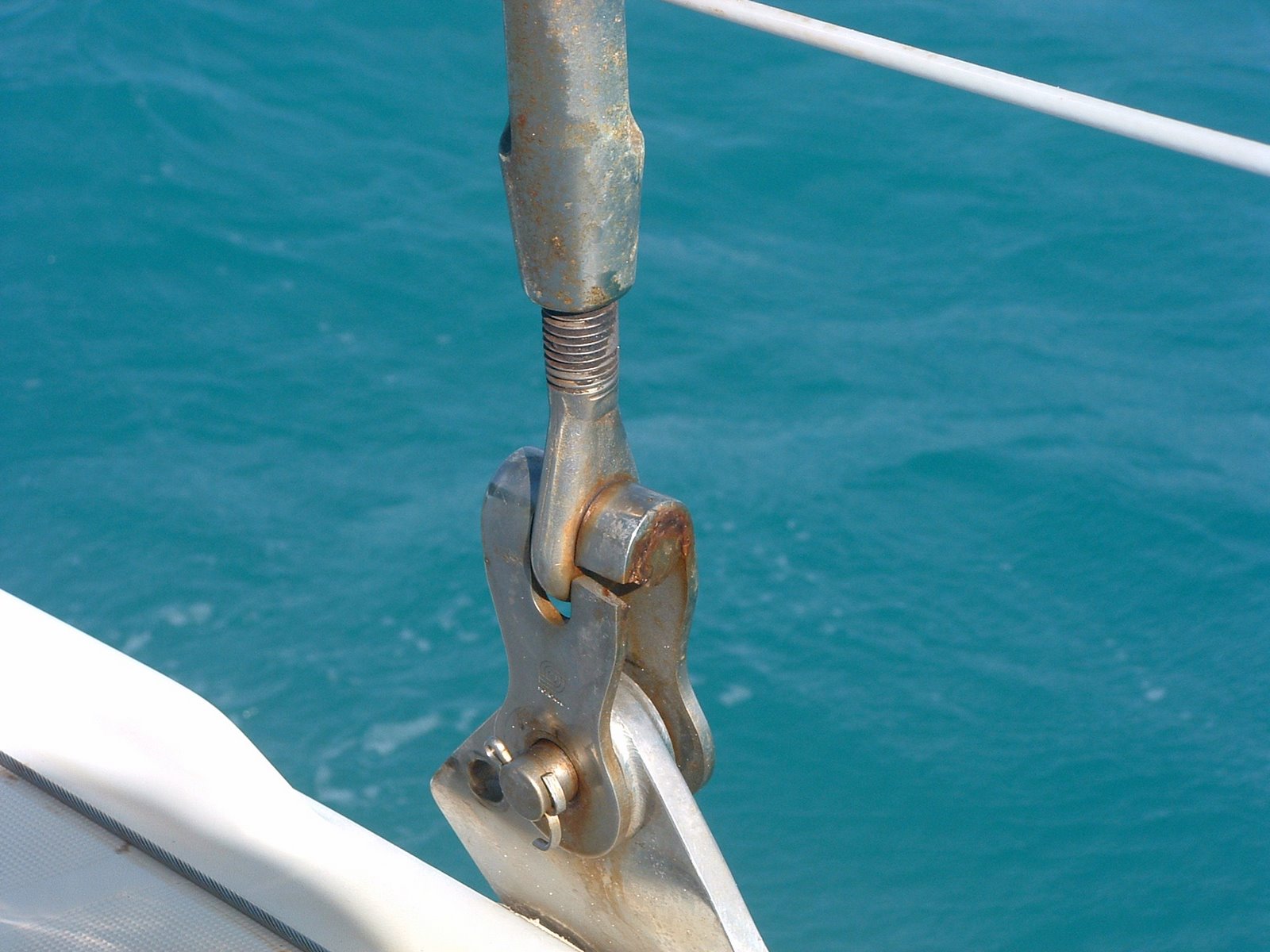
We had given up fishing when our lures disappeared not ten minutes after we had thrown them in the sea, but that was the least of our worries. Winds picked up, almost exactly from the direction where we wanted to go. Unfortunately they were accompanied by squall after squall after squall. Some of these were nothing more but very heavy rainfall, but some others were so violent, that we feared for our mast. We had been fixing our main roller-jib since Day 8, when it had ripped in a squall with a maximum windspeed of 45.5 knots and I had to remove one of the sail-battens at the same time, as the just repaired mainsail had chafed through in the same place again. On Day 13 this little job became a lot less important as we had been crashing into about 7 Beaufort and in a lull I heard a sound outside. First I couldn't find out what it was, but when the wind came back, my ears told me soon enough. One of the blades of our windgenerator had broken off and somehow flown against the wind into our cockpit. As there wasn't any sun to be seen, we immediately had problems with electricity as the autopilot needs to run on Response Level 3 in these conditions. That, together with our fridge, sucked the amps out of our batteries far faster than we could put them in without running the engines.
Also, with all the water sloshing around, our bilge pumps were busier than usual which needs plenty of power as well. The next day our trampolines disintegrated, the port-center bilge pump stopped functioning and so did the foot pump. I was slowly getting fed up with all this. Way too early! The next thing I discovered was my whole library swimming in plenty of seawater and just a little while after that a mighty squall with a maximum windspeed of 56.7 knots hit us where the boat stopped reacting to the rudder although we had two reefs in the main and only a tiny triangle of the Mylar-jib unfurled. That time I really got scared.
When the squall had finally departed, I checked the foredeck and discovered that our anchor chain had partially disappeared through the holes where the water is supposed to go and were acting like a big drogue under the boat. No wonder I couldn't steer properly any more! So of course I had to crawl into the anchor locker and pull up the chain hand over hand, while being thrown all over the place and smashing various parts of my body into all kinds of hard (and very dirty) surfaces. Did I mention that I was upside-down? I invented all kinds of brand-new and very strong swearwords while I got the chain back up and then repaired the damage as best as I could to prevent the same thing from happening again.
Day 16 found me steering almost all night, although I had the mainsail all the way down and the jib only partially unfurled. The reason were squalls all over the place and I was unable to tell whether they were "good" or "bad" squalls. Losing the mast was on my mind every minute of that very long night. Perhaps I was overreacting because of the 56.7-knot-squall, but when I later heard that another catamaran had indeed lost her mast in similar conditions, I was grateful that my stick still stood.
The next day I stood at the mast when the jib sheet suddenly caught me across the face and my sunglasses (which are regular glasses with a double dark mirror-coating) got thrown over the foredeck. Of course a wave broke on deck at the same time, so that my precious sunglasses were already hanging half overboard and I scrambled to retrieve them before it was too late. The salt and the water had made the deck quite slippery and before I know what was going on, I managed a major crash-landing which ended in the life-lines and a major shock for myself. Another excellent reason for wearing a harness at all times when on deck. I don't think one has even the slightest chance of survival if one actually gets thrown overboard in rough seas like that. Even with the sails down, the windage of a modern cruising catamaran is such, that it takes a very good swimmer to get back to the boat in time. Never mind wearing boots and foul-weather-gear.
This kind of stuff went on and on for three weeks and when our GPS died and the dinghy-cover tore to pieces, I was ready to swear that only madmen go to sea for pleasure and where was the pleasure anyway? I was also very glad that we have 3 independent GPS systems on board. Very very glad.
When we finally dropped the anchor in Tarawa, we were stupid with fatigue and exhaustion. I just went to bed and resolved to work on the unbelievable mess the next day.
The next day was Sunday, 11/11/2007. Again the weather turned squally and bad, so that I got nervous and started up the engines and the chartplotter. False alarm, the anchor seemed to be holding. Later, at around 6:15 p.m., it wasn't a false alarm anymore and remembering our lesson from Lautoka all too well, we started both engines and both chartplotters. You never know. Then things got really interesting. A big cargo ship next to us started dragging, while I had to turn up the revs to assist our anchor. We had dragged a few meters, but were stable again, when we saw that more and more of the fishing ships were in trouble themselves. A big catamaran-ferry dragged past us and disappeared behind us somewhere. Behind us was the reef with numerous wrecks on it. An ultra-modern fishing boot drifted sideways towards us, but there was absolutely nothing we could do. Maximum windspeeds were "only" 43.2 knots, but there were too many ships about, water was flying all over the place and I couldn't see. Fortunately the ship got under control again. A gray police-vessel was crashing into the pier as waves had reached a height of about two meters and were breaking in the shallow lagoon. I saw an ambulance there and lots of people trying to prevent further damage, but it took about two hours until the boat managed to leave the pier and head out into the coral-head-studded lagoon.
Meanwhile I was shivering, scared, exhausted, and from constantly steering to keep our bows into the wind, I experienced something which I have never experienced in my life before. Stone-cold sober I couldn't hold a beer in my hands anymore. It kept slipping out of my grip and finally I realized that I had to put it down somewhere and give my muscles a break. By that time I was ready to swear any oath that I would never ever have anything to do with boats, the sea and similar things again. Grab an oar and walk uphill in hilly country until people ask what that funny thing is you are carrying. Then you know you are far enough away from the sea and can settle down safely.
By the time the wind went down to 30 knots a semblance of normality returned and after watching things for a while, I switched off the engines.
The next day we went ashore to clear in and when we asked people here, whether that kind of weather was normal at this time of the year, every single one answered with an emphatic "Yes!" We almost went back to the boat to leave at once. Like my friend Jörn Grote in Trinidad likes to say: "Paradise is getting crowded. Let's go to hell!"
Later we found out that nobody understood our question and the custom here in Kiribati is to answer yes to questions you don't understand. In fact, it hadn't rained in about four months before our arrival and they called that squall "The Storm". The navy vessel had actually been thrown on the reef, but apparently they got it off again without too much damage.
The first thing we noticed in Betio was an amazing amount of people. There were houses, huts, shacks and stalls simply everywhere with hardly enough space to squeeze through. How did they all find enough to eat? And yet, they all looked well nourished tending to compact. And almost everybody was smiling, laughing, singing or chattering away happily. Prices were comparable with Tahiti, if not higher, and yet the average wage per month is somewhere between 300 and 400 dollars. It takes extended families with at least one wage-earner abroad or in the government here to make ends meet and the current estimate is that one of the money-making I-Kiribati actually supports 20 people in his extended family.
When we finished with customs and the barefoot officer had inspected DHARMA BUM III, we set off to the neighboring island of Bairiki, where immigration is to be found. We got our passports stamped and found out that we were allowed to stay for two months and since we were already on the island, we went in search for the Taiwan embassy.
Everybody seemed to know where it was and people told us to look out for a beautiful flower garden. We found it soon enough and were welcomed with open arms by ambassador Samuel Chen, first secretary Wallis Zhou and the rest of the staff. "You did well in coming here right away," ambassador Samuel Chen said. "Isn't this like coming home to mother after a long stay abroad?" He showed us around his beautiful garden where some of his artwork is displayed as well, as Samuel Chen likes both sculpting and painting.
Wallace Zhou immediately arranged a meeting with VP Temaia of the Betio Shipyard, when he heard that we had sustained some damage on the way up and invited him and us to lunch at "Aboy's Kitchen", a Chinese restaurant in Betio. We were very grateful and quite amazed at the speed at which things were happening. Lunch was just over, when ambassador Samuel Chen told us, that secretary Louis Liu would take us to the Taiwan Technical and Agricultural Mission and Research Farm. They are part of the International Cooperation & Development Fund, which we knew about from Panama, where our friends Kunmu Zheng & Meihua Lin work for the ICDF as well.
It was quite a long drive and on the way we saw that it wasn't only Betio which was highly populated. All of South Tarawa seemed to be one big village, with one house standing almost wall-on-wall to the next one. Many of the roofs were thatched with Pandanus leaves and almost all the houses stood on stilts, with pigs and chickens living under them. Breadfruit trees grew all over the place, which not only explained where some of the food was coming from as the fruit of the Pandanus palm is edible and quite tasty as well. The trees, Pandanus and coconut palms provided shade on top of everything, which is most welcome.
At the farm we met Farmer Wu, who has worked his miracles in similar projects for over 40 years. According to him, the soil here is the worst he has ever encountered, which is one reason why they also raise pigs and chickens to produce organic fertilizer. The water simply disappears in the porous ground and when one digs only a meter and a half one encounters salt-water which seeps in from the ocean. Also all the plants have to be protected with wire-mesh against rats, crabs and whatnot. And yet... He manages to grow the most sweet and tasty tomatoes imaginable, several kinds of cucumbers, cabbages, radish, chives, green onions, squashes, watermelons, and so on. It is absolutely astonishing! He heaped some of the produce into our hands until we had to tell him that we simply couldn't take any more as it would certainly spoil and go bad on the boat. And our friend Herbert Salvenmoser, who had come here on his trimaran BAMBOO last season, had said that vegetables were very scarce here? And for that matter, we had heard that we had to expect calms as well as very hot and humid weather. In actual fact, we feel chilly after sunset in the cockpit and before sunrise we have to wrap ourselves in the sheets to avoid the cold.
By now we've been here for almost two weeks and we have been almost overwhelmed by the people here. Zeppo and Fiji-Ben from Betio Shipyard helped to remove the ripped trampolines and were just as happy and smiling as everybody else. The little boats dangerously overloaded with singing I-Kiribati always come close to wave, cheer and shout and even the foreigners here seem to be infected with the general good cheer. This is not to say that there aren't any problems here. Quite the contrary, actually. Overpopulation, underemployment, poverty,pollution, alcoholism, lack of education, incompetence at all levels, the rising level of the water etc etc all give rise to concern. But the barefoot people here seem to deal with things differently and so far it hasn't stopped them from giving all the outward appearance of happiness which reminds me of the barefooted Tongans in Ha'apai in 1987. Still, many dream of leaving the islands one day.
Wallace Zhou had mentioned that there would be a run of the Kiribati Hash House Harriers ("The drinking club with a running problem!") the following Wednesday and invited us to come along. I had run a few hashes in Taipei, which were affairs of two to three hours under the hot subtropical sun, in mountainous terrain and extremely humid - not to say dripping - jungles. Very interesting, and usually followed by beer-drinking sessions of apocalyptic proportions which only ended when everyone was in a near-catatonic state.
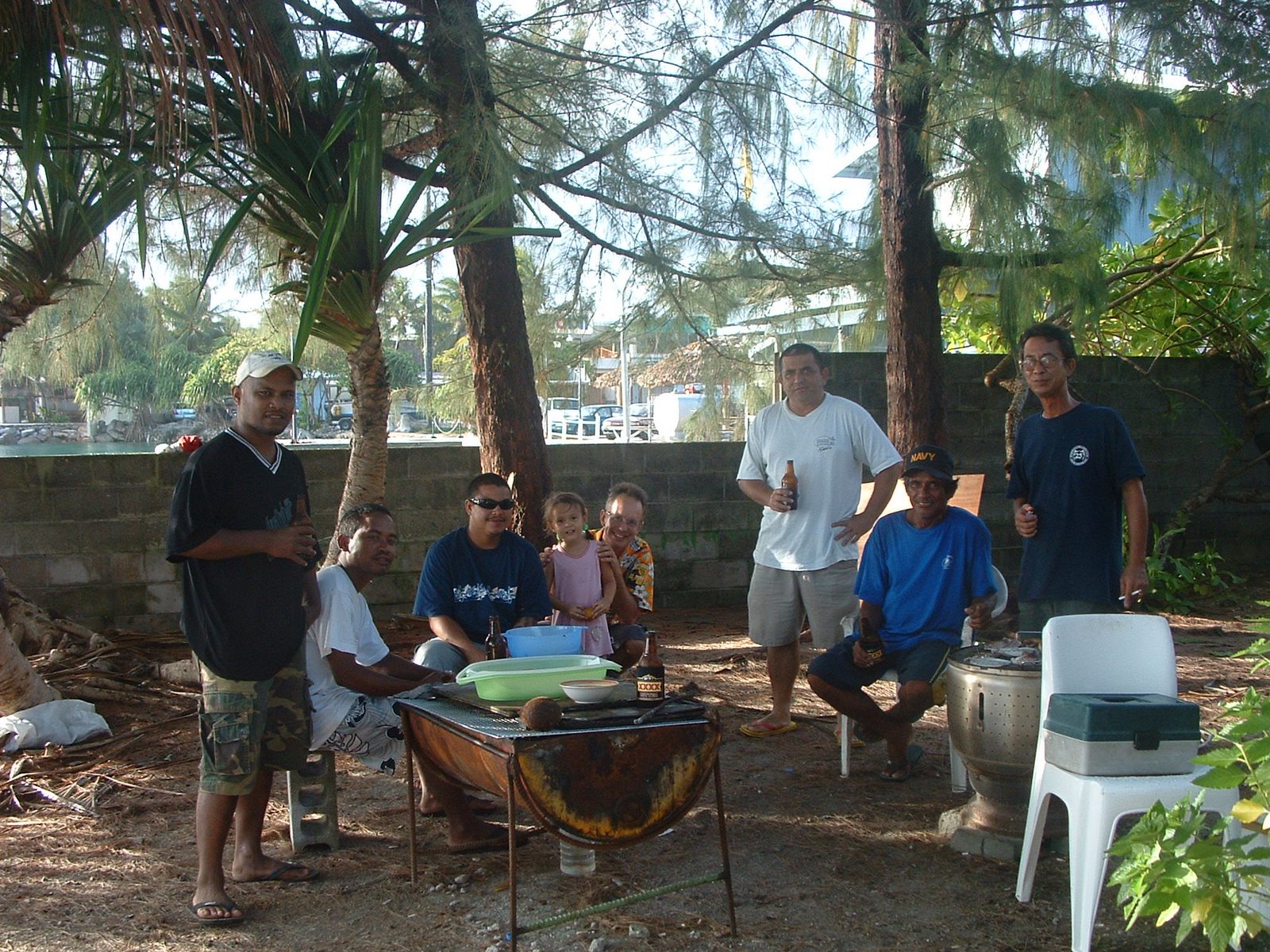
Things were slightly different here. A short walk of about an hour followed by a can of XXXX-Bitter or two with most of the Hashers being diplomats, foreign aid workers, lecturers of the University of the South Pacific (USP), I-Kiribati of all walks of life and their friends. I spent most of the time talking to Mike, who is the director of the US Peace Corps here. Liping and Aurora Ulani were talking to a former Miss Kiribati and her equally beautiful friend. We got our first introduction into expat-life here and were pleasantly surprised. Also we received invitations left, right and center, so that we could already see our social life taking off like an Ariane 5 rocket.
Sure enough. Saturday the Taiwan Embassy arrived with seven people to check out how we lived on DHARMA BUM III and later on we sat with Samuel and Wallace in the cockpit while our Rhino kerosene pressure lantern provided some pleasant light. Our guests shared one can (!) of beer and the conversation was lively and interesting.
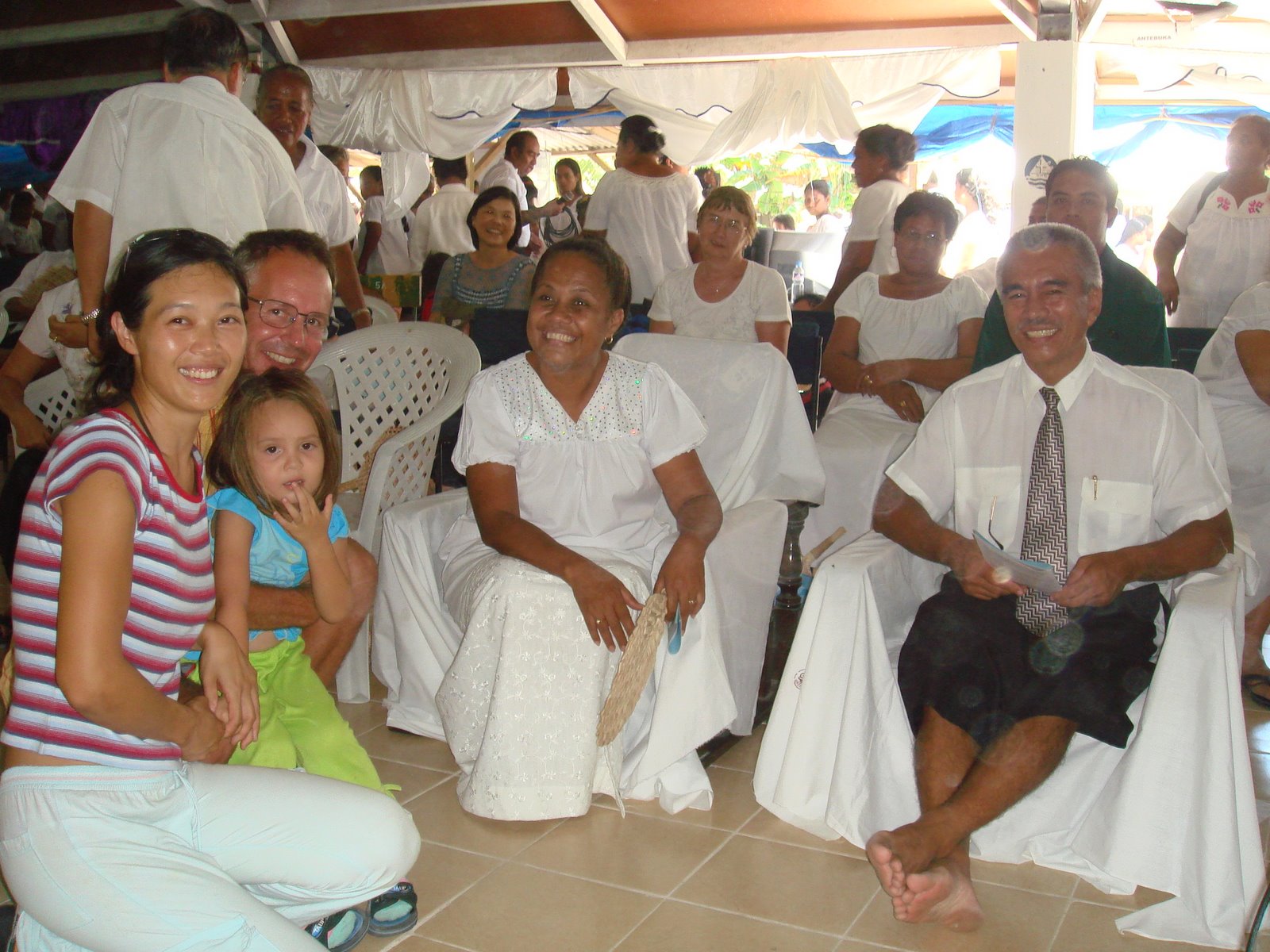
On Sunday we took part in the celebrations for the 150th anniversary of the Kiribati Protestant Church, or KPC, as it is called here. We were introduced to the President of the Republic of Kiribati and the First Lady and couldn't quite believe the amount of food which was provided for everybody. At least five well-sized pings on a spit were devoured which were accompanied by hundreds of other dishes of every variety of island fare imaginable. It was delicious and naturally I made the mistake of many a newcomer and ate way too much.
The next Hash happened to take place at the research farm and I talked a long time to one of the Aussie-lecturers at USP and a Kiwi called Greg, who was very interested in our sailing experiences and turned out to be the High Commissioner of New Zealand. He also invited us to enjoy his swimming pool and offered to drive us to the Thanksgiving dinner which Sheila from the US Peace Corps had arranged. We intended to go back on the beer truck with I-Kiribati Molly and her daughter and found Tab from Tuvalu sitting in the loading area. We drank a few more beers on the way back and when we went past "The Captain's Bar", Tab decided that we had to have a few more drinks over there. Tab is a civil engineer cum businessman and as we could plainly see, he is also an avid sportsfisherman. According to the board on the wall, his sailfish holds the current local record.
Sheila is originally from the U.K. and spent the last 29 years in around 30 different countries, mostly in Africa. She experienced the horrors in southern Sudan, where whole villages were massacred, her ambulance was machine-gunned and she decided it was time to leave. She also enjoyed the beauty of Malawi, where the Chens as well as the Cais (who run the ICDF here) served for a time as well. I found her life-story fascinating and could have listened to her for the rest of the night, but unfortunately it was getting late.
The Chinese have a story about "hypnotizing people with poisonous legendary insects" (guhuo) to make them do what they don't really want to do. This is a bit how we feel at the moment, since the trip up here and the squall after our arrival were so bad that we had resolved to sail to Australia, pay the hefty import duty and hand over our boat to a yacht broker in order to sell it. But then we wouldn't meet all these friendly and interesting people anymore, now would we?
Anyway, right now we are busy trying to find a used Garmin GPSmap 175 chartplotter, a 12-Volt motor for our Lofrans Leopard anchor-windlass, seals for our hatches, seals for our toilets, circuit breakers for our 12-Volt system as well as trying to repair the trampolines, sails, dinghy-cover and about a zillion other things. That should keep us busy for quite a while, especially as we also like to spend some time with The Happy People of Kiribati.
--
Holger Jacobsen
S/V DHARMA BUM III
SHIP-IN-TRANSIT
c/o Embassy of Taiwan
P.O. Box 104
Bairiki, Tarawa
Republic of Kiribati
+68693662